The Falcon-XL methane detector that Vanguard flies over pipeline corridors did not begin as a methane product. It began as a mounting problem — how do you attach a precision sensor to a certified aircraft, power it, control it from the cabin, and keep the airframe safe and legal? Eagle Pods, LLC has been solving that problem across nine countries and twelve industries, and the Falcon-XL is one answer among many. This is a look at the engineering capability underneath it.
One of the innovative solutions offered by Eagle Pods, LLC is their Custom Aircraft Sensor Pods, designed for versatility in various applications. These Custom Aircraft Sensor Pods are tailored to meet specific industry needs and enhance aerial data collection capabilities. The company specializes in creating highly efficient Custom Aircraft Sensor Pods that integrate seamlessly with various airframes.
Eagle Pods, LLC designs and builds airborne sensor pods — externally mounted housings that carry cameras, lasers, and other sensors on manned aircraft. The company is based at Maple Lake Municipal Airport in Maple Lake, Minnesota, and classifies itself as an aviation and aerospace component manufacturer. Its expertise, in its own framing, lies in effectively mounting various types of sensors to aircraft.
That distinction matters. Eagle Pods is not primarily a camera company or a laser company. It is a company that solves the integration problem between a sensor and an airframe — the structural mount, the power, the cabin control link, and the aerodynamics. The sensor inside is, to a meaningful degree, interchangeable.
Eagle Pods emerged in 2021 as an offshoot of Eagle Eye Photography, LLC, when the decision was made to separate the products from the services. Eagle Pods is owned by Vanguard Pipeline Inspection, LLC, which operates the Falcon-XL commercially for pipeline operators across North America.
A plug-n-play sensor pod is a self-contained, battery-powered sensor housing that mounts to an aircraft without modifying it. Eagle Pods applies this pattern across its entire catalog, and it is the clearest expression of the company’s engineering philosophy. Every pod shares the same four design commitments:
The engineering consequence is that capability becomes portable. An aircraft is not committed to a single mission profile; it carries whichever pod that day’s work requires, and reverts to a stock airframe when the pod comes off.
| The Core Thesis: Fixed-Wing Aircraft Doing Helicopter WorkEagle Pods describes the Recon Surveyor as “a helicopter in a box” — a cost-effective alternative to traditional helicopter filming systems. That phrase captures the company’s whole thesis. Founder James Aarestad has, by the company’s account, bridged the gap between fixed-wing aircraft and tasks traditionally handled by helicopters.It is the same argument the Falcon-XL makes in the pipeline sector: a fixed-wing methane survey can be flown for a fraction of the cost of a traditional helicopter system. |
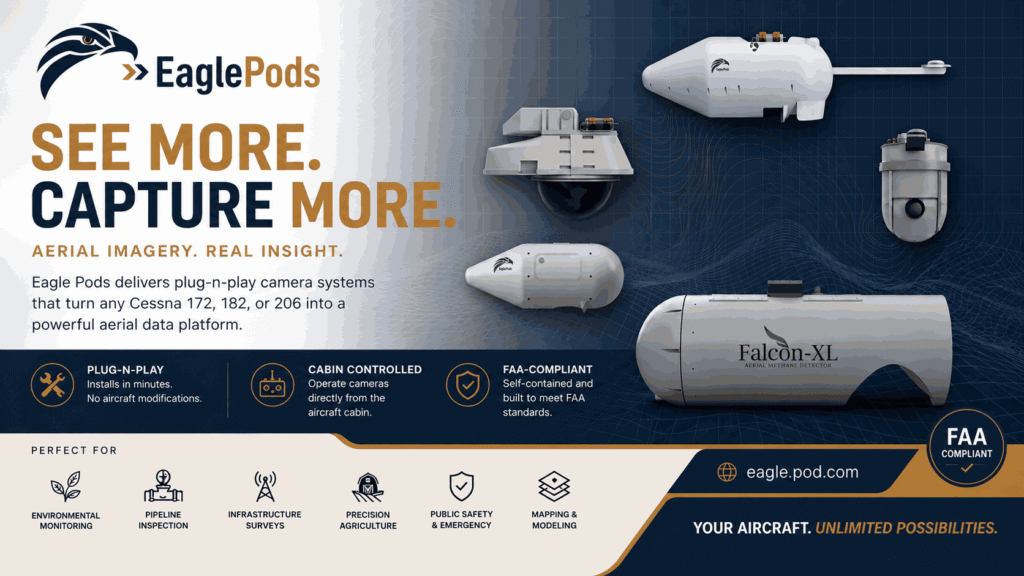
Eagle Pods integrates optical cameras, gimbal-stabilized video systems, LiDAR scanners, multispectral cameras, optical gas imaging cameras, and TDLAS laser methane sensors. The catalog below shows how far the same architectural pattern stretches across sensor types.
| Pod | Sensor / Payload | Mission |
|---|---|---|
| Falcon-XL | Class 1 laser | Methane detection |
| Falcon-XL HeliPod | Class 1 laser | Methane detection |
| Recon OGI / OGI Mini | Optical gas imaging camera | Visualizing hydrocarbon leaks |
| Recon XL | Multi-payload; nadir and oblique | Aerial mapping |
| Recon XL Carbon | Multi-payload; RGB, NIR, LiDAR | Aerial mapping |
| Recon Surveyor | DJI Ronin RSC 2 3-axis gimbal | Stabilized aerial filming |
| Recon SkyTagger | Geotagging computer | Exposure-instant position logging |
Three of these deserve a closer look, because they show the range of the underlying capability.
The Recon XL and Recon XL Carbon are the clearest proof of the sensor-agnostic argument. Both are multi-payload pods that accept sensors in nadir and oblique orientation, and the payload is swapped to suit each project rather than the pod being replaced. The Recon XL’s published compatibility list runs to the Phoenix LiDAR Ranger XL, the Hasselblad A6D, Phase One cameras, multispectral cameras, DSLRs, mirrorless bodies, and camcorders. The Carbon variant is described as housing RGB cameras, NIR cameras, and LiDAR equipment. One airframe, one mount, one certification pathway — and a payload chosen per contract.
On Phase One specifically, Eagle Pods describes itself as a trusted systems integrator partner. Its own published disclaimer is careful to note that this association does not imply sponsorship or endorsement by Phase One Geospatial.
The Recon Surveyor is built around the DJI Ronin RSC 2 gimbal — which Eagle Pods says makes it the first camera pod designed around that gimbal. It stabilizes at focal lengths beyond 500mm and accepts camcorders, DSLRs, and mirrorless bodies, so operators swap cameras and lenses to suit the mission rather than buying a new pod.
The Recon OGI pairs hardware with software. A specialized camera renders hydrocarbon plumes that are invisible to the eye, an artificial intelligence program scans each flight’s footage for signs of a leak, and the system colorizes any plume it finds for fast identification. A video technician then confirms the leak before the location is documented. Footage is geotagged so leak positions can be logged in post-flight analysis.
Eagle Pods discontinued the Recon-DJI pod after DJI moved away from the open architecture its earlier drone cameras relied on. The pod had been designed around a repurposed DJI M600, letting operators fly any camera compatible with that platform. When the architecture closed, the product was retired rather than reworked into something compromised.
For a buyer evaluating a pod manufacturer, that is a more useful signal than any spec sheet. It says the pods are genuinely built around their payloads rather than around marketing, and that a discontinued product is treated as a discontinued product on the public catalog.
Eagle Pods systems can be installed on Cessna 172, Cessna 182, and Cessna 206 aircraft as well as numerous helicopters. Custom mounting systems can be developed for other airframes.
The choice of airframes is deliberate rather than incidental. The C-172, C-182, and C-206 are the workhorses of utility patrol, survey, wildlife management, and law enforcement aviation. Building to those three covers most of the fleet the customer base already owns, which is why a pod can turn an aircraft an operator already flies into a mapping, filming, or leak detection platform without acquiring anything new.
Eagle Pods offers customization services for operators whose payload does not fit an off-the-shelf pod. Its engineering team works from the customer’s sensor backward — designing the pod around the payload rather than asking the payload to fit an existing enclosure. LiDAR systems and multispectral cameras are both named as integration targets.
The company’s stated approach runs roughly as follows:
The pitch to prospective customers is stated plainly on their site: when off-the-shelf solutions will not suffice, the custom pathway exists.
Eagle Pods reports operations in 11 countries and 12 industries served. Its named customer categories are news networks, law enforcement, utility companies, survey companies, fish and wildlife agencies, state DNRs, film studios, and oil and gas companies.
The breadth is itself the capability argument. A pod that satisfies a film studio’s demand for stabilized long-lens footage, a survey firm’s demand for geotagged orthomosaic accuracy, and a pipeline operator’s demand for regulatory-grade methane data is not three unrelated products. It is one mounting-and-certification competency pointed at three different sensors.
Founder James Aarestad entered the aerial imagery business in 2009 and has accumulated more than 11,000 flight hours, working across blimps, helicopters, drones, and fixed-wing aircraft. The pods reflect an operator’s priorities — minutes to install, minutes to learn, nothing bolted permanently to the airplane.
Yes. Eagle Pods rents and leases across its lineup, including the Recon XL, Falcon XL, Falcon XL HeliPod, Recon SkyTagger, Recon Surveyor, and the Recon OGI and OGI Mini. Rental suits one-time projects and ongoing operations alike, and it lets an operator prove a mission profile before committing capital.
Separately, Vanguard Pipeline Inspection offers Pod Leasing Services for pipeline operators who have their own flight crews and want the Falcon-XL in-house with the pipeline survey and compliance reporting layer attached.
Who manufactures the Falcon-XL methane detection pod?
The Falcon-XL is manufactured by Eagle Pods, LLC of Maple Lake, Minnesota. Eagle Pods is owned by Vanguard Pipeline Inspection, LLC, which operates the system commercially for pipeline operators across North America.
Does Eagle Pods build custom sensor pods?
Yes. Eagle Pods offers customization services and designs pods around a customer’s specific payload, including LiDAR systems and multispectral cameras. Custom mounting systems can also be developed for airframes outside the standard Cessna approvals.
Do Eagle Pods systems require modifying the aircraft?
No. The pods are self-contained, battery powered, strut-mounted, and install in minutes with no modifications to the aircraft. They are controlled wirelessly from the cabin.
Which aircraft are Eagle Pods systems approved on?
Eagle Pods systems can be installed on the Cessna 172, 182, and 206. Custom mounting systems can be developed for other aircraft.
What sensors can Eagle Pods integrate?
Across its catalog and custom work, Eagle Pods integrates TDLAS laser methane sensors, optical gas imaging cameras, LiDAR scanners including the Phoenix Ranger XL, RGB and NIR cameras, multispectral cameras, Phase One and Hasselblad medium-format systems, gimbal-stabilized video rigs, and DSLR, mirrorless, and camcorder bodies.
| The Engineering Behind Vanguard’s FleetVanguard flies the Falcon-XL because the mounting-and-certification problem was solved before the methane problem was. If you are evaluating aerial methane detection for your pipeline corridors, start with Vanguard’s aerial methane detection overview. If your payload is something else entirely — a LiDAR scanner, a multispectral array, a camera system with no pod built for it — that conversation belongs with Eagle Pods’ engineering team at eagle-pod.com/custom-pods. |
Vanguard Pipeline Inspection, LLC is a Minnesota-based technology company specializing in aerial methane leak detection for oil and gas pipeline operators across North America. Vanguard operates the Falcon-XL TDLAS aerial detection system — — field-validated on over 150,000 miles of pipeline through its partnership with Energy Transfer, with a 90% probability of detection at 10 kg/hr.
Vanguard offers turnkey Patrol Services and Pod Leasing Services. The Falcon-XL is manufactured by Eagle Pods, LLC, a Vanguard Pipeline Inspection company.
Contact Vanguard Pipeline Inspection to discuss patrol coverage, pod leasing, or technical consultation at vanguardpipeline.com.